National Research Foundation (NRF)
Funder-specific guide

The National Research Foundation (NRF) is a government mandated research and science development agency that funds research supports the development of high-end human capacity and critical research infrastructure to promote knowledge production across specific disciplinary fields.
Researchers who are or aim to be NRF grant holders are bound by particular funder-specific processes and systems. At UCT, NRF-funded research is co-managed by the researchers and dedicated UCT support units along all stages of the research project lifecycle.
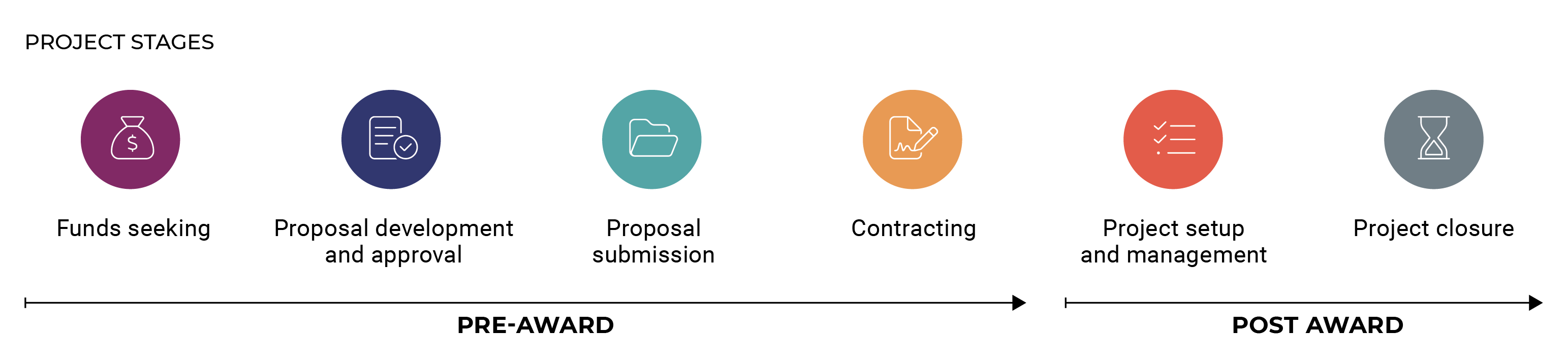
This funder-specific guide is compiled to assist you, the UCT researcher, with all necessary steps and resources to successfully take your research project from application to closure. Browse this page for details or use the drop-down below to jump to the particular section.
Pre-award: Funds seeking | Proposal development and approval | Proposal submission | Contracting
Post-award: Project setup and management | Project closure
Summaries: Roles and responsibilities | Resources | Contacts

NRF funding opportunities usually fall into one the four categories:
Applications for NRF funding must be in response to a call.
Open calls for NRF funding opportunities are distributed as they become available via email to the UCT researchers via the Research Announcements and other mailing lists. UCT has designated authorities (DAs), assigned by the UCT Research Office and registered with the NRF, who receive and distribute the open calls and serve as the official point of contact between UCT and the funder. Open call information can also be found online on Open Calls (NRF) and Current Funding Opportunities (UCT Research Support Hub).
Most calls open in the year preceding the first year of the grant.

When applying for NRF funding, take note of the internal UCT application deadline as this is usually earlier than the closing date of the NRF funding call. If you are unsure of the internal deadline, check with the UCT designated authority (DAs) assigned to the call.
The full framework document for funding calls can be found on the NRF website. Applicants are encouraged to read the full framework before applying. The following sections are of importance:
All applications for open NRF calls are completed via the NRF Connect portal. The portal provides prompts and has a detailed set of instructions to assist you step-by-step along the application process. Read the instructions and hint text carefully. Sections marked with a red asterisk (*) are mandatory and the system will not allow you to progress until these are completed.
Once you have completed the application form on the NRF Connect portal you will need to upload the supporting documentation. A list of the required supporting documentation can be found in the full framework document and is call-specific.
NRF calls may require:
Once all the necessary points in the application process have been completed and the required supporting documentation uploaded on the NRF Connect portal you can submit your application, via NRF Connect, for UCT-internal review and approval to the respective UCT designated authority (DA).
The application must be submitted for internal review by the internal deadline. The internal deadline is in place to allow for sufficient time for the necessary review of your application before it is submitted to the NRF which increases your likelihood of success. Internal deadlines are published with the call for submission. At this point the application has not gone to the NRF, but rather to your DA who will run a technical review involving a series of checks and balances to ensure that your application and budget are complete, accurate and correctly packaged for the NRF’s requirements.
Applications for Thuthuka and Competitive Support for Unrated Researchers (CSUR) require an academic review. Your DA will notify you if an academic review is required and will make the necessary arrangements for the review. Reviewers are generally academics internal to the University.
Your DA will notify you of the outcome of the internal review via email before the submission deadline.
Where applicable, your DA will reopen the application on NRF Connect to allow you to edit your submission. Finalise the application based on the feedback received and resubmit it via NRF Connect to your DA. You and your DA will receive a notification of the submission.

Your UCT designated authority (DA) accesses your application via NRF Connect, conducts a final check and endorses and submits your application to the NRF. Once this step is completed you receive a notifcation via NRF Connect of the successful submission.
You can track the status of your application on the NRF Connect portal. Navigate to "My Application" on the left hand side and click the relevant application form. An NRF review panel will meet to review all applications. Outcomes, both successful and unsuccessful, will be sent to you and your DA and published on the NRF website.
The NRF has developed guidelines for appeals for some calls. Should you wish to appeal the outcome of your NRF application, contact your DA who can advise accordingly.

The official contract with the NRF is the Conditions of Grant (CoG). The terms and conditions contained in the CoG are binding once you have accepted the NRF funding award (as per Stage 5 below).
In certain instances, the UCT Research Contracts and Innovation (RC&I) office assists in drafting sub-contracts. Contracts are typically required with:
For information not specific to funder, see also Stage 4: Contracting.

If you received notification from the NRF that your application was successful and the funding is being awarded, the UCT Research Office will send you a follow-up email with instructions and guidelines on how to access your award letter and the Conditions of Grant (CoG) from the NRF Connect portal. You need to log on to NRF Connect to accept your award; the instructions and guidelines sent by the UCT designated authority (DA) will assist you in this process. It is suggested that you download both the CoG and the Award Letter and save a copy and maintain them on your records.
You may be required to submit additional supporting documentation such as Ethical Clearance Certificate (described on the Ethics page) or proof of registration which may not have been complete or available at the time of application.
Once you have accepted your grant and uploaded all required supporting documentation, a notification is sent to your DA. The DA then logs on to NRF Connect to review your supporting documentation to ensure it is complete and accurate and will refer to you with any queries. Once satisfied, the UCT DA accepts the grant on NRF Connect – this is the “institutional acceptance” of the NRF award – and downloads the CoG and all supporting documentation to maintain on the Research Office’s records.
Once your DA has institutionally accepted your award on NRF Connect, they will email you a guideline document on how to open a fund at UCT. The document will also be sent to:
You must complete an Application to open a fund (FM003a) form to request a fund to be opened. The form must be submitted to the SFO, with a copy to crf_nrf@uct.ac.za. See the guide Application to Open a Fund (FM003a) Help to assist you in completing this form.
CRF reviews and signs off on the FM003a form, reverting to you if any information is missing or incomplete; they will then forward the form on to Ledgers to enable them to open a fund in SAP. Ledgers then opens a fund in SAP and notify you via email.
Once a fund is opened, CRF will assist you in preparing a budget request aligned with the award letter and CoG. The Assistant Finance Manager (AFM) in CRF will review and signoff on the budget approval and will create a budget control fund in SAP. The budget control fund allows you to monitor and control the expenditures and commitments against a specified budget for the fund.
The amount as included in your budget will then be transferred into this fund and will be available for spending. You and your Administrative Assistant will be notified of this via email; accompanying this email will be a set of spend rules and a summary of special requirements pertaining to your grant and its conditions.
Running costs can be used for research related to the project that was approved by the NRF. Please review the spend rules and summary of special requirements carefully and ensure you spend in line with these rules and your approved budget. Failure to do so will result in penalties being levied against the University and a possible withdrawal of your funding. The UCT Central Research Finance (CRF) office can provide guidance on spend rules and how to apply them.
As the grant holder it is your responsibility to ensure that you spend the allocated amount for the relevant year timeously and in line with the CoG and UCT’s policies and procedures. Depending on your specific requirements, CRF will pull weekly/monthly/quarterly (depending on your requirements) BOBJ reports detailing your spend and available fund balance and will send these to you via email to assist you in tracking project spend.
Tip: it is recommended that you spend budget throughout the year and do not wait until the year end.
In certain instances changes to your NRF funding may be required this could include: adjustments between funding categories, grant deferrals, budget deviations, institutional transfers or PI transfers. In these instances, you must contact the Senior Finance Officers in CRF to draft a motivation which your DA will send to the NRF. If approved, your DA will notify CRF to make the necessary adjustments in SAP; you will be notified as well.
The UCT Research Office will notify you when the NRF opens the call for the submission of progress reports; the email will include instructions and the deadline.
You are responsible for providing an accurate and complete account of progress against the approved objectives, milestones and commitments for the reporting period.
Annual NRF progress reports are required to report on the year that has been and to motivate for any unspent funds to be carried forward to the next year. NRF opens the call for submissions in November, but as a grant holder you are encouraged to start your reporting process – specifically the narrative content – as soon as possible to ensure compliance with the submission deadline.
NRF will not release funds for the following year until receipt of a satisfactory progress report.
To submit your NRF progress reports:
For detail on the SARChI 5 Year-Review process, please see the process flow linked below.
Process map: NRF SARChI 5 Year Review Process
Once submitted, the report is reviewed by the NRF and forms part of the conditions for the continuation of funding. Late, incomplete or non-submission of progress reports may result in delays to funding or other grant management actions.
The UCT Central Research Finance (CRF) office serves as the primary point of contact with the funder providing general reminders and updates to you as required.
Researchers can obtain a research fund monitoring and reporting toolkit from CRF. CRF also provides guidance on reporting and spending and interpreting UCT’s policies and procedures, your award letter and CoG.
CRF is responsible for reconciling expenditure against budget and claiming the funds back from the NRF. They also assume responsibility for working with the NRF to balance any under- or over-claimed amounts. CRF review and sign-off is required for specific NRF-related transactions before they can be claimed. They include:
Expenditures related to Postdoctoral Research Fellows and Postgraduate students will need to be reviewed and signed off by the Postgraduate Funding Office (PGFO).
Review this process guide for NRF Postgraduate Funding Applications.
Process Guide: NRF Funding Applications
The National Research Foundation (NRF) requires you to spend your full grant allocation within the approved funding year.
If you anticipate underspending due to valid project-related delays, you must notify UCT’s Central Research Finance (CRF) early and provide a clear motivation explaining the reason for the underspend and how the funds will be used in the following funding year.
Where funds awarded towards operating costs, including running, sabbatical and equipment costs, remain unspent or unclaimed at year-end, these may be eligible for consideration under the NRF’s carry-forward process. Funds are not automatically carried forward and remain subject to NRF rules and approval.
SFOs can assist with information on how much you can motivate for.
SFOs in CRF prepare and submit the carry forward request to the NRF via NRF Connect in line with NRF’s instructions and deadlines. This process usually takes place in January each year.
NRF communicates the outcome of carry-forward requests to the University as part of its annual year-end process, this is usually in around March/April. CRF will notify you of the outcome and any actions required.

NRF grants end when the funding does. On conclusion of the grant, UCT Central Research Finance (CRF) Office conducts a final reconciliation and once satisfied, will close the fund on SAP.
SARChI grant holders are required to prepare a project closeout report. The report contains a publication impact section, which you compile with UCT Libraries. The final report is reviewed and signed off by the Research Support Hub Director: Research Support Enterprise, who also submits the report to the NRF on your behalf.
For information not specific to funder, see also Stage 6: Project closure.
fulfilled by various support teams