Donations and Donors
Donations-specific guide
UCT welcomes philanthropic donations to support research activities. Whether you are planning to submit a new proposal for a research donation or you have already secured donation funding, follow the steps below to ensure your donation is correctly processed and managed.
A research donation is a charitable gift given to UCT, either in cash or as assets. Donations may be:
A donation is given without expecting a commercial return, i.e. no quid pro quo. However, donors may reasonably expect UCT to honour the donation’s broad purpose.
Note: Donations are distinct from funded research projects, which involve deliverables, intellectual property, or other commercial considerations. If your funding has conditions like these, it may not qualify as a donation.
If you are unsure whether your funding qualifies as a donation, or if you would like assistance preparing or processing a donation, email the Development and Alumni Department (DAD) for guidance.
An infographic has been developed to visually represent the research donations process at UCT.
Infographic: Donations for research activities
Use the steps below to guide you through the research donations process at UCT.
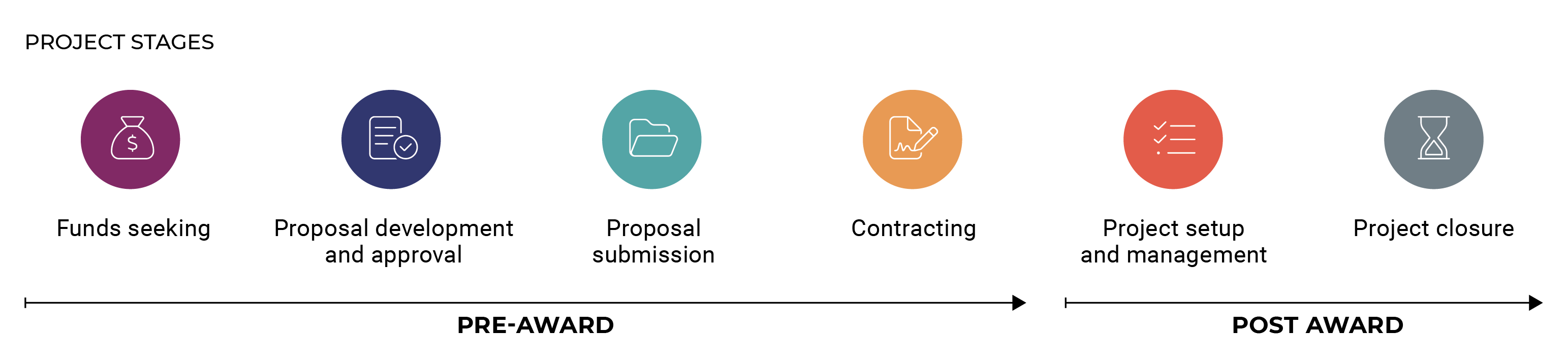
Pre-award: Funds seeking | Proposal development and approval | Proposal submission | Contracting
Post-award: Project setup and management | Project closure
Summaries: Roles and responsibilities | Resources | Contacts

Research donations may arise when:
Sometimes you will submit a proposal for a research donation, and in other cases a donor may have already made an offer of donation funding confirmed via e.g. an email or award letter. Even if no proposal is submitted, any confirmed donation must still be formally recorded and processed through UCT’s systems to ensure accurate institutional records and compliance.

As the custodians of fundraising and donations at UCT, Development and Alumni Department (DAD) must be informed of all donor engagements – whether initiated by you, DAD, or the donor. This ensures alignment with donor histories and institutional fundraising strategies.
If the opportunity is valued at over R3 million, or involves a strategic donor, notify your Dean early for transparency and approval. The Dean must confirm in-principle approval to pursue the opportunity and highlight any existing commitments with that donor.
Faculty Finance must be involved before you draft the proposal or accept a donation. Notify Faculty Finance of your intention to submit a proposal or accept a donation. They will help you consider potential hidden costs such as internal audit costs, reporting and admin requirements and cost recovery implications.
If you are drafting a proposal: Prepare a draft using the donor’s template, or a UCT-aligned motivation, and discuss it with Faculty Finance.
If the donor has already confirmed funding: Complete the UCT donations template to formally recognise the research donation and share it with Faculty Finance.
The following forms apply:
In both cases Faculty Finance will conduct an initial classification review and check for clauses or conditions that may prevent the funding being treated as a donation.
If Faculty Finance identifies that there are deliverables, IP terms or commercial elements, the funding will not qualify as a donation and must follow standard UCT research funding processes via UCT eRA.
This requires:
DAD will conduct two key assessments:
If the donation is restricted, your proposal must clearly show:
Faculty Finance will work with you to develop or refine the budget, which forms part of the final submission to the donor.
If the opportunity exceeds R3 million, you must again inform your Dean at this point, confirming that the final budget has been prepared.
Finalise your proposal and submit it to DAD for review via email. DAD’s proposal writers may assist you in refining and strengthening the proposal to improve its chances of success.
Where institutional sign-off is required, the Executive Director: DAD will review and approve the proposal on behalf of UCT.

Note: This step applies only when a proposal must be submitted to the donor. If the donor has already committed the funding, and the steps above confirm it as a bona fide donation, you may proceed directly to Stage 4: Contracting.
Once the proposal is finalised and signed by the Executive Director: Development & Alumni Department (DAD), if required, either you or DAD submit it to the donor, depending on the donor’s requirements. If you submit the proposal, notify Development & Alumni Department (DAD) of the submission by email.

Once a donation is confirmed, complete the required donation agreement template in consultation with the donor. During negotiations, if any revisions arise, discuss the changes with the Development & Alumni Department (DAD). DAD will assess if the revisions affect the donation classification.
You also prepare the draft donation contract or agreement and send it to DAD for review. DAD will review the agreement for:
If new terms or conditions introduce deliverables, IP, or other commercial elements, your funding may no longer qualify as a donation. If DAD determines that this is the case, you will need to follow UCT’s research funding processes via UCT eRA. See Stage 4: Contracting.
DAD completes the Grant Checklist required for internal UCT approvals.
DAD oversees and manages the entire internal approval process.
As the PI/Fund Holder you review and sign the grant checklist. It is then reviewed and signed by:
Higher-value donations may require approval and sign-off from:
Once all internal approvals are in place, send the final agreement to the donor for signature.
Once signed by the donor, email a copy of the signed agreement to the Development & Alumni Department (DAD) and the applicable Faculty Finance.

Engage frequently with the Development & Alumni Department (DAD). DAD plays a key role once a donation is secured, issuing tax certificates where required and ensuring compliance with legal obligations, including Section 18A for South African donors.
They also manage donor stewardship, maintaining relationships, reporting on donation impacts, and ensuring donor intentions are honoured to encourage ongoing support for UCT’s research.
Keep DAD informed as your research progresses reporting back regularly on the use and impact of the donation.

Closing a donation project properly ensures transparency, honours donor intent, and keeps UCT compliant with legal, tax and audit requirements while also supporting positive long-term donor relationships.
Follow the steps below to close out a research project funded through a donation.
Once the research activities funded by the donation are complete, or the donation is no longer required, confirm that the project is ready to be closed. This may be triggered by:
Notify Faculty Finance and Development and Development & Alumni Department (DAD) that the donation-funded project is ready for close-out.
In consultation with DAD, confirm whether the donation agreement or correspondence requires:
DAD will advise on any outstanding donor obligations and coordinate donor communication where required.
Faculty Finance will conduct a final financial review to ensure that:
You may be asked to confirm that all research-related expenditure is complete.
If a balance remains, the next steps depend on the donation terms and UCT policy:
Faculty Finance and DAD will guide this process and ensure decisions are formally approved and documented.
Before closure, confirm that any related obligations are complete, including:
All documentation must be retained in line with UCT’s audit and records management requirements.
Once all financial, donor and compliance requirements are met:
You will be notified once the close-out process is complete.