South African Medical Research Council (SAMRC)
Funder-specific guide

The South African Medical Research Council (SAMRC) aims to improve health in South Africa through research, innovation and technology transfer. It focuses on laboratory investigations, clinical research and public health studies, addressing South Africa’s quadruple burden of disease: maternal, newborn and child health; HIV/AIDS and TB; non-communicable diseases; and interpersonal violence.
The SAMRC Self-Initiated Research (SIR) Grants Programme supports original research initiated by researchers at recognised institutions in various health-related fields. Grants of up to R200,000 per year are available for a maximum of three years, covering research expenses, with the expectation that researchers/applicants already have the necessary equipment and facilities in place for the proposed work. The SAMRC-SIR programme primarily targets early-career scientists, but mid-level and established researchers can also apply, provided they demonstrate a clear focus on capacity building.
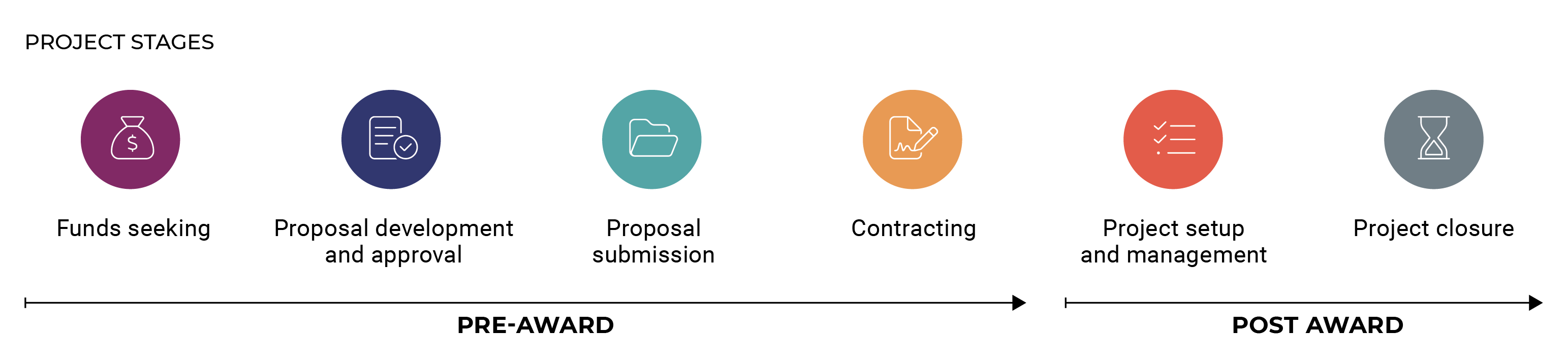
This funder-specific guide is compiled to assist you, the UCT researcher, with all the necessary steps and resources to take your research project from application to closure. Browse this page for details or use the drop-down below to jump to a particular section.
Pre-award: Funds seeking | Proposal development and approval | Proposal submission | Contracting
Post-award: Project setup and management | Project closure
Summaries: Roles and responsibilities | Resources | Contacts

The call for SAMRC-SIR grants opens annually. Open SAMRC-SIR calls are published via these channels:

Before starting the proposal, confirm your eligibility for a SAMRC-SIR award. Check the opportunity announcement for specific requirements, but typically, applicants must:
Queries about SAMRC-SIR applications, including eligibility can be directed to SIRApplications@mrc.ac.za.
Complete UCT’s online Intention to Submit: Research funding form to indicate your intention to submit a SAMRC-SIR grant application.
UCT eRA’s internal deadlines are earlier than the call’s closing date. Diarise and plan for these deadlines as published in the funding opportunity announcement.
Before submitting the application, consider whether ethical clearance is required for the research. Ethical clearance is only needed once the proposal is awarded, as SAMRC will not release funds without confirmation that ethics approval is in place, but it is important to plan for it in advance.
Proposals are developed in the Research & Innovation Management System (RIMS), the platform SAMRC uses to manage research funding applications. Once the proposal is complete, download it from RIMS for internal review by UCT via UCT’s electronic Research Administration (eRA) system. After UCT approves the proposal, submit the final version through RIMS to UCT’s Research Contract & Innovation Office (RC&I), who submit it to SAMRC on behalf of the institution.
Review this process guide on the proposal development and approval process for SAMRC-SIR grants.
Process guide: SAMRC-SIR grants
Review this process guide on securing pre-award approval via UCT eRA.

UCT's Research Contracts & Innovation (RC&I) is notified that the application is ready for submission and submits it to SAMRC via RIMS on behalf of UCT. RC&I will only submit the application once it is fully approved via UCT eRA and the pre-submission process via RIMS has been completed.
You receive an email confirmation from SAMRC that the application has been received. Forward this confirmation to:
RC&I updates the status of the application to “Submitted” via UCT eRA and captures the confirmation email.
SAMRC reviews applications, and eligible ones undergo peer review and rankings to determine the final list of awardees. Applicants are notified via email of the outcome of the application.
Update the application status via UCT eRA to reflect the outcome:
Updating the status of the application with the outcome via UCT eRA ensures that the record is complete, enabling smoother future submissions, providing visibility on funding outcomes and supporting effective tracking of the PI’s research progress.

If awarded, an acceptance of grant letter will be emailed to you. This letter outlines the terms and conditions of the SAMRC-SIR grant and serves as formal acceptance of the award. See example: Generic acceptance of SAMRC-SIR grant letter.
Three signatures are required on the acceptance letter:
Add your electronic signature to the PDF acceptance letter and email it to the FHS Research Development team.
The FHS Research Development Team will batch acceptance letters and submit them to Central Research Finance (CRF) for signature. Once signed by CRF, the acceptance letters are forwarded to RC&I for the final institutional signature. They will also ensure that RC&I is made aware of the awardees and the need for their signature.
You award will be assigned to a legal advisor in RC&I who will sign the acceptance letter and return the fully signed document to you.
Once you receive the acceptance of grant letter signed by all three parties (yourself, CRF and RC&I), forward the fully signed document to SAMRC.
SAMRC will acknowledge receipt of the signed acceptance letter. At this point, the acceptance letter is considered binding.
While RC&I is signing your acceptance of grant letter, as part of Step 1, they simultaneously log the award via UCT eRA and upload a copy of the fully signed acceptance letter against the contract record, using a reference number starting with “UCT”.
The Legal Advisor in RC&I will update the UCT eRA contract status to one of the following:
The Legal Advisor will the change the status to “Completed in RC&I” to close the contract record.
UCT eRA will then automatically generate a unique reference number beginning with “PRJ”, confirming that the award has moved into the post-award module.
No further action is required from you unless RC&I contacts you for additional information.

In the first year of the SAMRC-SIR grant, a SAP fund needs to be opened from which to track and control the project's revenue and expenses.
Complete the relevant sections of the FM003a form and email it to Central Research Finance (CRF).
A Senior Finance Officer (SFO) in CRF will review the completed sections of the FM003a form and contact you with any questions. They will then complete the form, sign it and upload the signed version to the tab "fund opening approvals" on the UCT eRA record. The SFO will assign a SAP number to the fund, and Ledgers will receive a notification to open the fund in SAP. The SAP number will be recorded via UCT eRA in the tab "fund information" against the appropriate project number, beginning with "PRJ".
For more details on opening a SAP fund, visit Stage 5: Proposal setup and management.
SAMRC-SIR grants are "spend and claim projects" meaning that UCT provides upfront funds to you to start the project, which are later reimbursed by SAMRC.
Once the fund is opened, Ledgers update the record via UCT eRA to "Fund opened" and notify CRF via email that the budget can be loaded. CRF access the final, approved budget via UCT eRA and load the required amount into the fund.
For more details on loading a budget, refer to Stage 5: Proposal setup and management.
Conduct the research according to the approved proposal and budget and ensure you meet all obligations and conditions outlined.
Use SAMRC funding strictly for the research activities specified in the proposal. The funding is intended solely for the approved project and requests for using it for other purposes, such as conference attendance, are unlikely to be granted.
Refer to the SAMRC's allowable expenditure guidelines in the acceptance of grant letter.
Do not use SAMRC funding for non-research-related items like laptops, cell phones, or personal items. Desktop computers and printers may only be purchased if they are dedicated to the project or necessary for operating lab equipment, with clear justification.
Ensure the spending does not exceed the maximum amount specified for each expenditure category.
Be proactive in managing the project's finances and build a strong relationship with the Senior Finance Officer (SFO) at UCT Central Research Finance (CRF), who oversees the project finances.
Annual disbursements from SAMRC are based on the Annual Progress Report (APR) and contingent on satisfactory progress. Annual Progress Reports and Renewal Requests, on SAMRC's template, are due by the end of February annually. Failure to submit the APR will result in the termination of the grant.
The APR provides a detailed account of the project's progress, including:
It also serves as the application for annual funding renewal. If you are in the first or second year of the grant, complete the renewal request to apply for continued funding. You must also submit all publications to SAMRC on a quarterly basis.
In addition, you are required to report the project finances. A Senior Finance Officer (SFO) in UCT Central Research Finance (CRF) prepares annual financial statements for the project, which are reviewed and authorised by the Manager: CRF and UCT's internal audit before being submitted to SAMRC.
If you have unspent funds, you must request to carry them forward in the renewal application. Work with UCT CRF to identify the exact amount of unspent funds and provide proof of commitment, such as tax invoices or employment contracts, to support the request. CRF will assist you with securing the necessary documents. The renewal request should clearly outline how both the carried-forward and new funds will be used. In the third and final year of the grant, you cannot request a carry-forward of unspent funds and must only submit the APR.
Submit the completed APR, renewal request and carry-forward request to UCT CRF for approval and signoff. They will submit the documents to SAMRC on behalf.
SAMRC provides UCT CRF annually with a list of approved SAMRC-SIR grant holders at UCT and the associated amounts. CRF advances the money to you and invoices SAMRC quarterly for the amount. Invoicing takes place quarterly.
CRF verify the list received from the SAMRC to ensure it matches the funding they provided.
A Senior Finance Officer (SFO) in Central Research Finance (CRF) will use the approved list to complete an SD006: Research Invoice Requisition form, which will be authorised by the Manager: CRF and sent to Debtors to raise the invoice.
SAMRC pays into UCT's central bank account and Debtors manage any follow-up on outstanding payments.
You will be notified once the invoice has been sent.

At the end of the three-year period, the SAMRC-SIR funding cycle has ended, and the project needs to be officially closed. Any unspent funds will be returned to the funder.
The steps below outline the key activities required to close the SAMRC-SIR grant project.
At the end of the approved project, you must submit an End of Project Report (EPR) using the SAMRC EPR Template. This report must be with the SAMRC within 3 months of the project's end date. Failure to submit the EPR will prevent you from receiving further support from SAMRC until the report is submitted.
Send the EPR report to UCT Central Research Finance (CRF) to sign off and submit to SAMRC on behalf.
SAMRC has clear guidelines and statements on how SAMRC funding for the Self-Initiated Research project must be acknowledged in all related publications or publicity materials. Review the acceptance of grant letter for specific requirements and be sure to comply.
Complete section A of the FM007: Application to close a fund form to close the SAP fund. Send the completed form to the Senior Finance Office (SFO) in UCT CRF for sign-off. Once authorised, the form is sent to Ledgers who close the fund in SAP.
Follow the steps under Stage 6: Project closure to close the UCT eRA record.
The Senior Finance Officer (SFO) in CRF will be responsible for answering the finance-related questions in UCT eRA and completing the final declaration. When everything is in order, the UCT eRA status of the project will be changed to "Project award closure review by PI".
Go to the tab "Project Award Closure Information" to review the record.
Verify that all the project information is correct and all deliverables have been met, then tick the declaration to confirm.
Finally, update the record status to "Project award closed" to complete the project closure.