Wellcome
Funder-specific guide

Wellcome, a global charitable foundation founded in 1936, addresses health challenges by funding research in life, health and wellbeing. It supports discovery research across physical, social, data and life sciences, as well as humanities and clinical research, focusing on mental health, infectious diseases and climate and health.
Researchers who are or aim to be Wellcome grant holders must follow specific funder processes and systems. At UCT, Wellcome-funded research is co-managed by researchers and dedicated support units throughout the research project lifecycle.
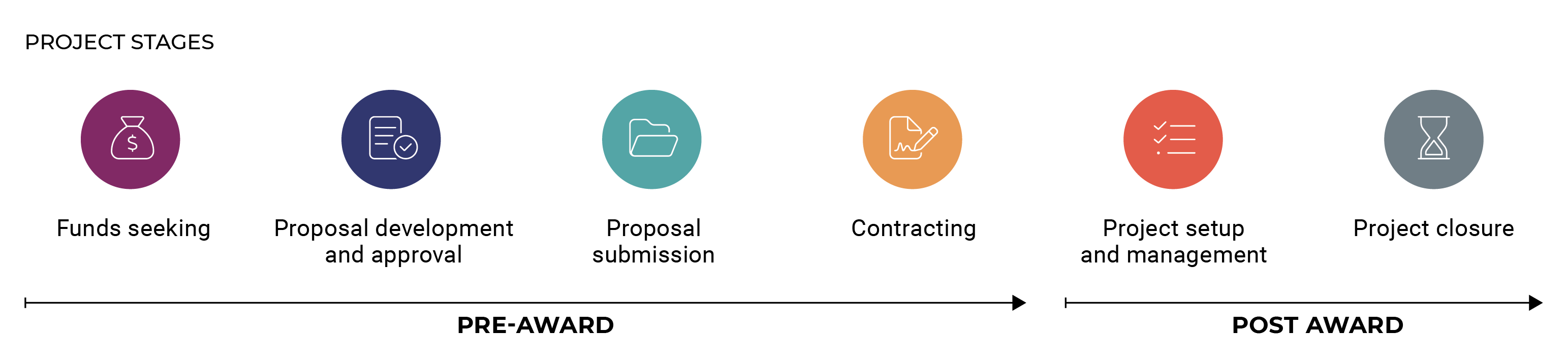
This funder-specific guide is compiled to assist you, the UCT researcher, with all the necessary steps and resources to take your research project from application to closure. Browse this page for details or use the drop-down below to jump to a particular section.
Pre-award: Funds seeking | Proposal development and approval | Proposal submission | Contracting
Post-award: Project setup and management | Project closure
Summaries: Roles and responsibilities | Resources | Contacts

Wellcome's funding opportunities are available throughout the year in response to specific calls. Open calls are published via these channels:

UCT-based researchers applying to Wellcome must follow two distinct processes:
Before starting the proposal, confirm your eligibility for a Wellcome award. Check the opportunity announcement for requirements. Both you and UCT must be eligible.
Complete UCT’s online form Intention to Submit: Research funding to indicate your intention to submit a Wellcome grant application. Indicate the level of support you require.
Completed forms are sent to the respective research support offices, which provide tailored proposal support based on your needs:
UCT eRA’s internal deadlines are earlier than the call’s closing date. Diarise and plan for these deadlines as published in the funding opportunity announcement.
Applying for a Wellcome Grant involves working across two systems:
Review this process guide for a detailed description on the proposal development and approval process for Wellcome grants.
Process guide: Wellcome grants Wellcome Funding
Review this process guide for step-by-step guidance on securing pre-award approval via UCT eRA.
Note: UCT eRA approval is for internal purposes only and does NOT send your application to the funder.
Proposals are developed in Wellcome's Funding Portal, the platform Wellcome uses to manage research funding applications. Once the proposal is complete, download it from Wellcome's Funding Portal for internal review by UCT via UCT’s electronic Research Administration (eRA) system.
After UCT approves the proposal, submit the final version through the Wellcome Funding Portal to UCT’s Research Contract & Innovation Office (RC&I), who submit it to Wellcome on behalf of the institution.
Wellcome applications require institutional approval by RC&I.

UCT's Research Contracts & Innovation (RC&I) submits all Wellcome applications. During this step they review your proposal and submit it to the funder via Wellcome Funding. Only applications fully approved via UCT eRA are sent to the funder.
You can track the status of your application via UCT eRA:
If UCT is a co-applicant, forward all UCT eRA-approved documentation (budgets, overhead justifications, institutional letters) to the primary applicant who does the submission through Wellcome’s funding portal.
Once you receive confirmation of submission to Wellcome, you must update the status on UCT eRA to “Submitted”.
Wellcome assesses all applications. Eligible ones undergo expert review, and shortlisted candidates are interviewed by a panel of Wellcome-selected experts. Wellcome emails you the results (either successful or unsuccessful), including an award letter if successful.
Update your application status on UCT eRA to reflect the outcome:
If the amount awarded by Wellcome, as detailed in the award letter, differs from your initial proposal, then initiate and submit a contract-stage approval through UCT eRA. DO NOT overwrite or edit the initial UCT eRA approval. Use the clone function to speed up the process.
All research awards require a contract (or similar agreement) outlining the grant’s terms and conditions. For Wellcome, the award letter serves as this document, but it must be approved by UCT's Research Contracts & Innovation (RC&I).
If successful, sign your award letter and email it to Research Contracts & Innovation (RC&I).
Before RC&I signs the award letter:
grees to the terms and conditions in the award letter.

Research Contracts & Innovation (RC&I) handles this stage with minimal involvement from you. During this stage they accept the award on your behalf and update the UCT eRA record. Track your contract status and provide information as requested.
RC&I logs your contract on UCT eRA (linked to the pre-award record), assigns a legal advisor and populates the contract record using your award letter. You receive a notification with a reference number beginning with “UCT”.
RC&I then signs off on the award letter and their internal authorisation sheet, uploading signed copies to UCT eRA.
Your legal advisor logs on to Wellcome Funding, completes the Grant Start tab and accepts the award on your behalf.

This section covers all you need to know about setting up and managing a Wellcome-funded research project, including the funder's requirements and expectations.
The Navigator provides guidance and advice on UCT's processes and requirements for project setup and management. It is a good idea to read it alongside this section for a full picture: Stage 5: Proposal setup and management
Wellcome requires ethics approval before any work on the research project can commence. If you have not yet obtained ethics approval, follow UCT's ethics approval process.
Wellcome requires that all funded researchers and organisations conduct their work responsibly, supported by institutional policies, structures and training.
Before you can commence work on the research project, you need to have attended UCT's Responsible Conduct of Research (RCR) training. Visit the Office of Research Integrity page for details on upcoming Responsible Conduct of Research (RCR) training sessions.
Consult Wellcome's page on Responsible conduct of research for clarity on Wellcome's expectations.
Carefully review the award letter, including approved budget, start and end dates and special conditions. Note which costs are covered and how Wellcome expects you to report on grant spending.
Review Wellcome's funding guidance Managing your grant to understand how Wellcome expects you to manage and conduct the research project. UCT, as the administering organisation, must comply with Wellcome's Funding policies and grant conditions.
If the project is a clinical trial, familiarise yourself with Wellcome's Clinical trials policy.
All project activity is monitored in a SAP fund, which contains specific income and expenditure and is usually related to one source of funds.
Before spending on the Wellcome grant can start, a SAP research fund must be opened, and the budget must be available in the fund. Wellcome grants are spend-and-claim projects, meaning that UCT provides upfront funds to you to start the project, which are later reimbursed by Wellcome.
For guidance on opening a SAP fund and loading budget, visit Stage 5: Proposal setup and management
Once the budget is loaded, the UCT eRA system will be updated under the tab “Budget Information” in the Contracts module.
Develop a clear and practical Data Management and Outputs Management Plan. This plan should outline how you will handle the data, software and research materials the project will produce. This plan is a living document and will evolve as the research progresses.
Make sure the plan:
If you are unsure where to start, check Wellcome’s data, software and materials sharing guidance on How to complete an outputs management plan or email UCT’s Digital Libraries team for support.
You are responsible for employing any staff required for your research project, ensuring all roles are included in the UCT and funder-approved budget.
Work with the Human Resources Business Partner (HRBP) and Faculty Finance for all staffing requirements.
Start this process early as the recruitment and/or appointment process at UCT may take some time.
Visit Wellcome’s Managing your grant for full details on what they fund and to access the required forms.
Only spend on items that are specifically listed in the award letter. Wellcome may refuse to cover costs that were not approved or differ significantly from the original, UCT, and funder-approved budget.
All expenses must be supported by clear documentation, keep invoices for everything. UCT must be able to fully justify every cost charged to the grant. You may not use Wellcome funds to supplement or top up funding from other sources.
See Wellcome's page Costs grantholders can claim on a grant for details.
Track expenses to avoid overspending and underspending.
You can make minor budget transfers between headings without Wellcome approval. However, you must contact Wellcome before transferring funds to or from:
Notify Wellcome if there are:
UCT uses a spend report for managing Wellcome grants. This means that grant funds are paid over to UCT quarterly and in arrears, i.e. after the money has been spent and reported to Wellcome.
The quarterly claim periods are as follows:
The Faculty of Health Sciences (FHS) Research Finance team is responsible for submitting quarterly spend reports for all Wellcome grants at UCT. Reports are submitted via the Wellcome Funding Platform.
At the end of each quarter, the Faculty of Health Sciences Research Finance team downloads a list of eligible grants from the Wellcome Funding Platform. For example, for the April–June quarter, the list will be downloaded in the first week of July.
Using this list, the team emails the relevant finance staff each quarter, requesting their reports. A standard reporting template is provided. The team also provides the required exchange rates for GBP grants. Wellcome requires monthly average rates, which are calculated using Oanda.com.
You and your finance manager/delegated signatory sign the claim, and it is returned to the FHS Research Finance Team for submission.
Once all claims have been received from the finance staff, the Faculty of Health Sciences Research Finance team consolidates them and submits a single claim via the Wellcome Funding Platform.
On occasion, Wellcome may come back with queries on the amounts claimed.
Wellcome makes two payments:
Payments are usually made 1–2 months after the claims are submitted.
Wellcome will release up to 90% of the grant during the active period. The remaining 10%, referred to as the retention amount, is only paid once the Final Expenditure Report (FER) has been submitted and approved.
You are responsible for the management of all individuals working on the grant in line with Wellcome's terms and conditions. This includes:
Visit Wellcome's page Managing your grant for full details on the support they provide to grant holders and their research teams.
For fellows: Wellcome covers the cost of employing fellows for the duration of the grant.
You are responsible for:
For students: Where you have students employed on the research project, the type of support provided by Wellcome depends on the student:
Promote a respectful, inclusive research environment by upholding Wellcome's policies such as the Bullying, harassment, abuse and harm policy, and Equity, diversity and inclusion policy. If you lead or supervise others, set a positive tone, support open communication and act on any concerns. Ensure fair access to opportunities for all team members and be aware that Wellcome may assess these practices through audits or reviews.
Welcome's Continuing professional development policy sets clear expectations for grant holders.
All Wellcome-funded Principal Investigators (PIs) and Co-applicants must complete at least ten days of continuing professional development (CPD) training each year as part of their grant award conditions. All other Wellcome-funded staff members (e.g. project managers, research assistants, technicians) are pro-rated according to their percentage time on the Wellcome grant.
When you complete a training event, capture these details to ensure we can track it correctly when you submit it.
Consult UCT's International Grants Hub (IGH) team for guidance, planning and opportunities.
CPD training can include but is not limited to activities like the responsible conduct of research, leadership and management training, and any of the activities offered by UCT’s Office for Inclusivity and Change (OIC) and Human Resources (HR) on topics such as Bullying & Harassment, Unconscious Bias, Critical Diversity, etc.
You can access over 100 potential training opportunities via UCT’s SuccessFactors Learning portal.
Other free online platforms like LinkedIn Learning, Khan Academy and Coursera have a wide offering.
Here is a summary of the training opportunities available via Success Factors:
| Category | Description | Example courses |
|---|---|---|
| Core Software & Digital Skills | Training in essential digital tools and software, primarily Microsoft Office and basic programming. |
|
| Finance, Accounting & Business Fundamentals | Courses covering financial literacy, accounting principles, and business decision-making. |
|
| Career Development & Workplace Skills | Guidance on career growth, workplace navigation, and professional effectiveness. |
|
| Leadership & Management | Skills for managing teams, leading effectively, and avoiding common management pitfalls. |
|
| Personal Effectiveness & Wellbeing | Focus on productivity, mental wellbeing, self-awareness, and personal performance. |
|
| Communication & Interpersonal Skills | Improving communication, writing, and customer interaction skills. |
|
| UCT Institutional / Compliance / Policy Training | Courses providing knowledge of UCT systems, governance, and institutional policies. |
|
| Research Integrity & Ethics | Structured programme covering ethical research practices and compliance requirements. |
|
| HR Systems & Development | Training on HR platforms and staff development frameworks used at UCT. |
|
| Mandatory Compliance / Legal / Conduct Training | Required training on institutional policies, legal compliance, and workplace conduct. |
|
Wellcome's Continuing professional development policy sets clear expectations for grant holders.
Engage in at least 10 days of CPD per year (pro rata) to strengthen your research, support your career development and contribute to an inclusive research culture. Keep a clear record of your activities, including:
Consult UCT's Office of Research Integrity for guidance and opportunities.
As a Wellcome-funded researcher, you must follow their guidelines and policies provided to ensure your work meets the highest ethical standards. The following Wellcome policies and guidelines are relevant:
The Office of Research Integrity offers support on ethics, misconduct prevention and CPD planning.
The research project is approved based on clear deliverables, milestones and deadlines, but delays or deviations can happen.
In certain instances, the grant's end date may need to be adjusted. The end date may change if:
Note: Wellcome will not approve a no-cost extension and a costed extension on the same award.
No-cost extensions of up to 12 months may be granted if there are remaining funds and the work aligns with the original grant activities. To request an extension, notify RC&I and the faculty finance manager in advance to confirm available funds.
Wellcome requires the following for assessment:
Submit the request via Wellcome's online form at least 2 months before the original end date. Extensions submitted after the grant end date will not be considered.
Wellcome considers requests for supplementary funding and additional time under two categories:
To request an extension, notify RC&I and the faculty finance manager in advance to confirm available funds. You can request up to 30% of the original award for a costed extension, with a maximum of 12 additional months.
Submit the request via the online form within the final 12 months of the grant and at least 3 months before the original end date. Late requests or those made with more than 12 months remaining will not be considered.
Include the following in your request:
You will receive an automated email on the anniversary of your funding start date to submit your annual progress report on the Wellcome Funding Platform.
You have four weeks to submit the report. You can assign guest editors to help with the report. No report is required if you are applying for an extension of six months or more or if you are on leave from the grant.
More information, including samples of annual progress reports can be found on Wellcome's webpage How to report grant progress.
The FAQs below answer common questions about CPD requirements, eligible training, and how to record completed training.
All Wellcome-funded Lead Applicants and Co-applicants must complete at least 10 days of CPD training each year as part of their grant award conditions.
All other Wellcome-funded staff members (e.g. project managers, research assistants, technicians) are required to complete CPD on a pro-rata basis according to their percentage time on the Wellcome grant. For example:
For Lead Applicants and Co-applicants, “part time” refers to employment status at UCT, not percentage time on the grant.
For all other Wellcome-funded staff members, the CPD requirement is pro rata according to the percentage of time allocated to the Wellcome grant, regardless of full-time or part-time employment status.
No.
For Lead Applicants and Co-applicants, the requirement is 10 CPD days per year in total, not per grant.
For all other staff members, the CPD requirement is calculated on a pro-rata basis across their Wellcome-funded grants.
Yes. The CPD training requirement applies to all Wellcome projects currently in progress, regardless of when the project started or when the policy was introduced.
The policy applies only to research staff at lead and co-applicant institutions, including universities and science councils.
The CPD policy applies to anyone employed to conduct research on the award and costed within the staffing budget, including:
The policy does not generally apply to administrative staff who are not directly engaged in conducting the research itself, such as finance officers or administrative assistants responsible for organising travel, meetings, or other logistical support.
More FAQs are in the process of being added to this list.
As a Wellcome-funded researcher, you must follow their guidelines and policies provided to ensure your work meets the highest ethical standards. The following Wellcome policies and guidelines are relevant:
The Office of Research Integrity offers support on ethics and misconduct prevention.
The research project is approved based on clear deliverables, milestones and deadlines, but delays or deviations can happen.
In certain instances, the grant's end date may need to be adjusted. The end date may change if:
No-cost extensions of up to 12 months may be granted if there are remaining funds and the work aligns with the original grant activities. To request an extension, notify Research Contracts & Innovation (RC&I) and the faculty finance manager in advance to confirm available funds.
Wellcome requires the following for assessment:
Submit the request via Wellcome's online form at least 2 months before the original end date. Extensions submitted after the grant end date will not be considered.
Wellcome considers requests for supplementary funding and additional time under two categories:
To request an extension, notify Research Contracts & Innovation (RC&I) and Faculty Finance in advance to confirm available funds. You can request up to 30% of the original award for a costed extension, with a maximum of 12 additional months.
Submit the request via the online form within the final 12 months of the grant and at least 3 months before the original end date. Late requests or those made with more than 12 months remaining will not be considered.
Include the following in your request:
You will receive an automated email on the anniversary of your funding start date to submit your annual progress report on the Wellcome Funding Platform.
You have four weeks to submit the report. You can assign guest editors to help with the report. No report is required if you are applying for an extension of six months or more or if you are on leave from the grant.
More information, including samples of annual progress reports can be found on Wellcome's page How to report grant progress.

The steps below outline the process required by Wellcome to close a research project. The Navigator's Stage 6: Project closure details the policies and procedures required by UCT to close a research project. It is a good idea to read it alongside this section for a full picture.
Submit an end-of-grant report within three months of your grant's end date, as required by Wellcome. The end date is determined by the original start date and grant duration. Wellcome will contact you after your grant ends to prompt submission.
The type of end-of-grant report you submit depends on your grant; check Wellcome's page End-of-grant reporting for details.
Reports are submitted either via Researchfish, Wellcome's research impact tracking system or via email at endofgrantforms@wellcome.org.
Two and five years after submission, you will be asked to update your Researchfish report during the annual submission window.
The final expenditure report becomes available on the Wellcome Funding Platform when the grant ends. UCT must submit it within 90 days of the grant end date.
The FER uses a different template from the quarterly reports, and the FHS Research Finance team shares this template with the finance staff ahead of time.
The FER is cumulative, covering all expenditure against each budget category from the start to the end of the grant.
Short explanations, up to 100 words, must be provided where the spend in a category is 35% or more above budget, or where there has been no spend.
Wellcome will release the final payment only once the FER and your End-of-Grant Report have been submitted and approved.
Wellcome allows a two-week grace period if late, but may close the grant and retain funds if the report is incomplete or delayed. No further payments will be made once the account is closed.
Include Wellcome and your grant number(s) in all research publications and outputs supported by their funding. Use full funder names and list grant numbers in square brackets.
Example: "This work was supported by the Wellcome Trust [123456], [789101]; Cancer Research UK [ABC123]."
All research outputs funded by Wellcome must be made openly accessible. This means publishing in journals or platforms that meet Wellcome's open access requirements, and making the accepted manuscript or final version freely available.
Any significant IP developments must be reported to Wellcome, and prior consent is required before entering into agreements to commercialise Wellcome-funded IP.
For details, see Wellcome's pages Open access guidance and intellectual property policies.
If you're moving to a new organisation or stepping down as grant holder, you can request a grant transfer, provided it is in the best interests of the research and team.
The new organisation must accept Wellcome's grant conditions and be outside of any international sanctions.
Notify Research Contracts & Innovation (RC&I), your Faculty Finance manager and your Wellcome funding manager early, as transfers may take several months. You will need to provide:
If approved, you may need to submit:
Transfers cannot proceed until the FER is submitted. A new award letter may be issued.
Each transfer is assessed individually.
Wellcome does not cover transfer-related costs such as relocation, new salary, or overheads.
If you are the lead grant holder and move during the award or within three years of it ending, equipment should move with you, except in Multi-user Equipment Grants, where it must remain at UCT.
Refer to Wellcome's page How to transfer a grant for full guidance on the process.