
Dr Revel Iyer awarded a Leaders in Innovation Fellowship

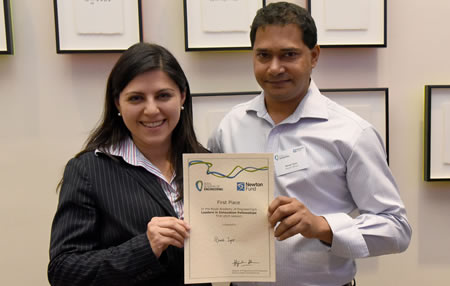
Dr Revel Iyer from Research Contracts and Intellectual Property Servicesâ (RCIPS) at UCT was recently awarded a Fellowship in the Leaders in Innovation programme in the United Kingdom during February 2016.
The Leaders in Innovation Fellowship (LiF) programme is run by the Royal Academy of Engineering and funded by the UK Government Department of Business, Innovation and Skills’ Newton Fund programme. The Fellowship brings the leading technology entrepreneurs from Newton Fund partner countries to the UK for an intensive training course on innovation whilst also building Business-to-Business networks with similar enterprises in the UK.
The primary objective of the LiF programme is to build the capacity of researchers for entrepreneurship and commercialisation of their research. A wider benefit of the programme will be the creation of international networks of innovators and technology entrepreneurs.
A consequence is that the programme is aimed at researchers within the partner country who are in the process of developing a business proposition for their innovation. At the end of the programme candidates pitch their technologies to a panel of judges.
Production of drought-tolerant maize
Dr Iyer was placed first at the pitching event amongst the South African cohort. His technology involves the production of drought tolerant maize by introducing genes from a resurrection plant that grows in the Drakensberg Mountains. The technology was deemed to be highly relevant to the African context and to be well placed to succeed. Significantly, South Africa, the largest maize producer on the continent, will reap a much reduced harvest this year after suffering the lowest rainfall since records began. The drought, which began in earnest in February last year, has severely affected the country’s 2014-2015 harvest, especially summer crops such as maize, sunflowers, soya beans, groundnuts, sorghum and dry beans. The drought tolerance technology is targeted specifically at mitigating such large losses of yield.
The second place pitch by Leo McNally dealt with the issue of load slipping or improperly secured cargo on trucks. A University of Stellenbosch spin-off, Cargo Telematics, aims to address this issue.
The device continuously monitors the tension in the cargo securing strap, automatically adjusts the tension in the strap when there is any change in tension and alerts the driver, fleet manager and/or insurance company of the event.
Third place went to Dr Busisiwe Vilakazi from the CSIR. She presented Umbiflow, which is a Doppler ultrasound device that can determine at the primary point of care, such as a clinic, whether a foetus that is small for gestational age is healthy or potentially sick. The device detects when the placenta is no longer providing sufficient nutrients and oxygen for the baby to reach its growth potential.