
SAUA Funds "The Locator" for Use at Universities
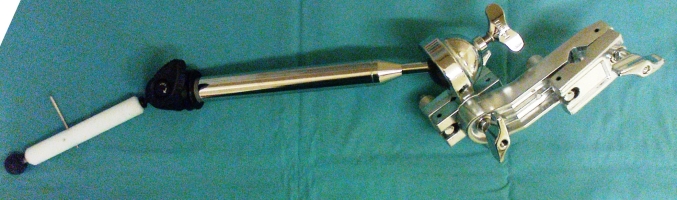
The Locator is a simple and cheap navigation aid for achieving accurate needle placement in a minimally invasive surgical procedures. It compares favorably to conventional manual puncture procedures which are often not even attempted due to the difficulty of the needle puncture process.
The device uses C-arm fluoroscopy to obtain puncture. It has two articulated arms with spherical joints providing full positioning capabilities. It is fixed to the operating table via a standard anesthetic screen. The working head consists of a radiolucent extension arm, hand controlled outside the fluoroscopy beam. The direction for needle advancement into the stone is determined by obtaining a needle superimposition or "bull's-eye sign" on the fluoroscopic screen. Through a metal guide on the working head, a "liver biopsy" needle is used for puncture of the lumbodorsal fascia. The C-arm is rotated to be able to estimate puncture depth for a disposable needle to make the renal and collecting system puncture.
In 2011, UCT filed a provisional patent to protect this promising technology. A number of large international and local medical device manufacturing companies are being approached as potential entrepreneurial partners to take this innovative device forward commercially.
Read the paper: Lazarus, J. and Williams, J. (2011). The Locator: novel percutaneous nephrolithotomy apparatus to aid collecting system puncture--a preliminary report. J Endourol. May 25(5), pp 747-50