
UCT Innovation Builder Fund is a funding stepping stone

Over the past five years, the University of Cape Town’s (UCT) Innovation Builder Fund (IBF) has become an indispensable catalyst in the university’s innovation ecosystem, providing early-stage support to research projects with strong commercial potential. Administered by the Research Contracts and Innovation (RC&I) unit, the IBF fills a crucial funding gap between early academic discovery and investor-ready technology, enabling nascent technologies to progress towards spin-off company formation and market-ready solutions. The university has invested R 27.3m into 52 projects since the Fund’s inception in 2019.
“UCT’s Innovation Builder Fund helps de-risk promising research and prepares it for later-stage investment,” said Dr Andrew Bailey, Director of RC&I. “We see time and again that this support accelerates the translation of academic ideas into real-world impact – often achieved via one of the university’s spin-off companies.”
Strengthening the Innovation Ecosystem
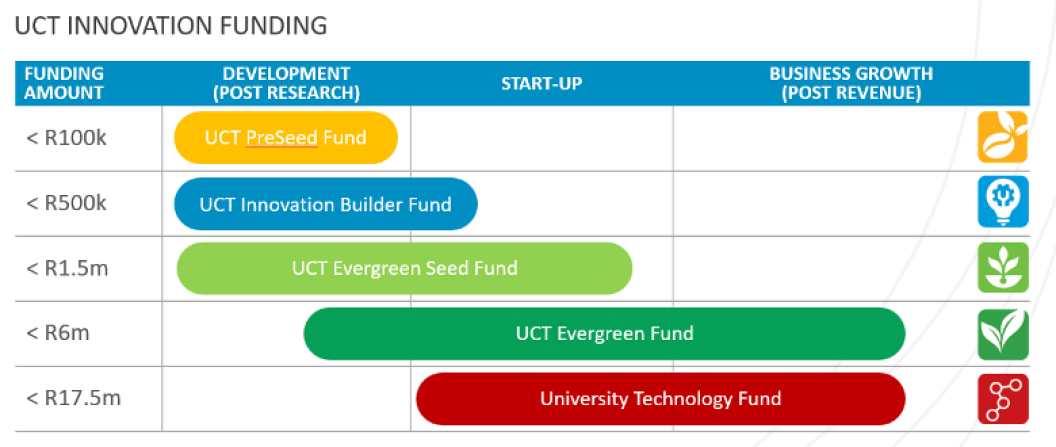
Over the past half-decade, UCT’s innovation funding landscape has evolved significantly. In addition to the Innovation Builder Fund, which typically provides up to R500k of catalytic internal grant funding, UCT has established various funds that act as key stepping stones in maturing technologies. These range from the earliest stage PreSeed Fund which provides grant amounts of up to R100k per projects to the Evergreen Fund which typically invests up to R6m per company.. These instruments work together to support innovations from early development through to more substantial external funding rounds, such as through the University Technology Fund (now investing UTF Fund II). UCT is a Limited Partner in the UTF II which enables UCT spin-off companies and our alumni ventures to approach the Fund for investment.
Technologies that received IBF support in the last few years that are being driven forward by Spin-off Companies
Khaya HealthTech – A health technology spin-off developing a diagnostic and therapeutic device for sleep-related conditions, expanding UCT’s footprint in biomedical engineering innovations.
Impulse Biomedical – Impulse Biomedical has developed devices such as the Easy Squeezy inhaler attachment and ZiBiPen auto-injector. Impulse Biomedical received regional recognition in 2025 at the inaugural Cape Chamber Innovation Awards for its contributions to accessible medical devices.
VasMedTech - VasMedTech’s flagship innovation, FlexiGyn™, is a portable gynaecological device developed by Dr Edmund Wessels under Professor Sudesh Sivarasu. It enables diagnostics like hysteroscopies without general anaesthesia, making it perfect for rural clinics or mobile outreach. FlexiGyn won the Royal Academy of Engineering’s Africa Prize for Engineering Innovation in 2023. First in UCT to win this prestigious continental award.
Acinotech - A spin-off company formed through collaboration between the African Robotics Unit and UCT’s Division of Exercise Science and Sports Medicine. The company develops biomechanics analysis tools that make advanced motion and body dynamics assessments more accessible. Aimed at supporting clinicians, coaches, athletes and other users by providing tools that help analyse movement, performance and physical mechanics in a user-friendly way.
Elemental Numerics – A UCT spin-off focusing on advanced simulation software for computational fluid dynamics (CFD). It commercialises state-of-the-art CFD tools (such as for cryogenic modelling) that enable engineers and researchers to model complex fluid flows. A core technology used in industries such as aerospace, energy, renewable technologies and advanced manufacturing.
MariHealth Solutions - A biotech spin-off company specialising in aquaculture health management, leveraging proteomics-driven solutions for sustainable aquaculture. In 2025, MariHealth was recognised for its contributions at the inaugural Cape Chamber Innovation Awards.

Driving Impact Across Sectors
These spin-offs illustrate the diversity of UCT’s innovation output, spanning clean energy, analytical instrumentation, biopharmaceuticals, MedTech and consumer health solutions. These ventures have leveraged targeted early-stage support from the IBF and guaranteed that UCT’s deep research expertise translates into commercial ventures with real economic and societal impact.
As UCT continues into 2026, RC&I’s coordinated approach to innovation funding is central to enabling even more researchers and entrepreneurs to transform world-class research into sustainable businesses that benefit South Africa and the broader global community.